Published by Perth Sleep Dentistry | Midland, Western Australia
If you’ve lost one or more teeth — whether through decay, gum disease, injury, or age — you’ve likely been weighing up your options. For most Australians, the decision comes down to two main choices: dental implants or dentures. Both can restore your smile and your ability to eat and speak comfortably, but they work very differently, carry very different costs, and suit different people for different reasons.
This article walks through everything you need to know to make an informed decision — including what each option involves, how they compare on comfort, longevity and cost, and how Australian private health insurance fits into the picture.
A dental implant is a small titanium post that is surgically placed into the jawbone, acting as an artificial tooth root. Once the implant has fused with the bone — a process called osseointegration, which takes around three to six months — a custom-made crown is attached on top, giving you a replacement tooth that looks, feels and functions just like a natural one.
Implants can be used to replace a single missing tooth, several teeth, or even an entire arch of teeth. For patients missing most or all of their teeth, a treatment called All-on-4 uses just four strategically placed implants to support a full arch of fixed replacement teeth — a more efficient and cost-effective alternative to placing individual implants for every tooth.
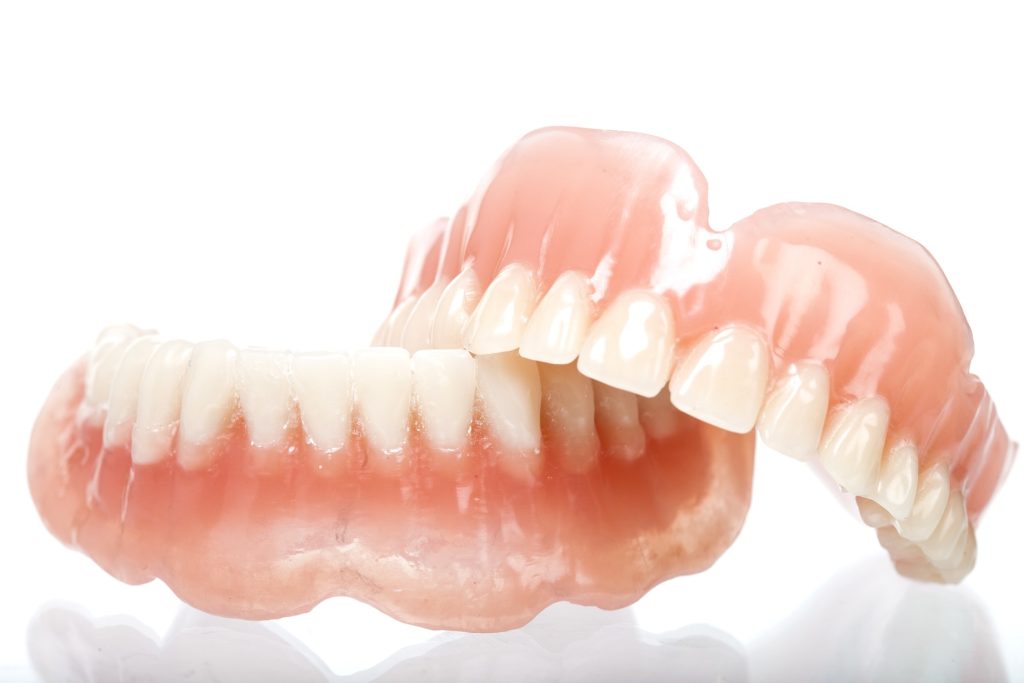
Dentures are removable prosthetic teeth that sit on top of the gums. They come in two main forms:
Full (complete) dentures replace all the teeth in the upper or lower jaw (or both) and are held in place by suction, adhesive, or a combination of both.
Partial dentures replace some missing teeth and typically clip onto remaining natural teeth for support.
Modern dentures are more comfortable and natural-looking than they used to be, but they remain a removable appliance — meaning they need to be taken out at night, cleaned separately, and can sometimes shift or slip during eating and speaking.
There is also a hybrid option called implant-supported dentures (sometimes called “snap-on” dentures), where a denture is attached to a small number of implants for a much more secure and stable fit. This is often a good middle-ground for patients who want the stability of implants without the cost of a full implant solution.
This is where implants have a clear advantage. Because they are anchored into the jawbone, implants feel and function like natural teeth. You can eat anything you like — including hard, crunchy or chewy foods — without restriction or discomfort.
Traditional dentures, while functional, can feel bulky, and may shift or move when you eat or speak. Many denture wearers avoid certain foods — particularly hard, sticky or chewy items — because of this. Sore spots on the gums are also common, especially in the early stages of wearing dentures.
Implant-supported dentures offer significantly better stability than traditional dentures, though they still cannot quite replicate the feel of natural teeth in the same way a fixed implant crown can.
Both options, when well-made, can look very natural. However, there is a longer-term consideration with dentures: because they do not stimulate the jawbone the way natural tooth roots do, bone loss continues to occur beneath them over time. This leads to a gradual change in the shape of the face — a sunken or aged appearance around the mouth — and means that dentures will need to be re-fitted or replaced as the jaw changes shape.
Implants, by contrast, actively stimulate the jawbone and prevent bone loss, helping to preserve the natural contours of your face over the long term.
Dentures require daily removal and cleaning with a denture brush and soaking solution. They should not be worn overnight. You will also need to clean your gums and any remaining natural teeth thoroughly.
Implants are maintained exactly like natural teeth — regular brushing, flossing, and routine check-ups with your dentist. There is no removal required and no special cleaning products needed.
This is an important consideration when comparing the true cost of each option over time.
A quality set of dentures will typically last five to ten years before they need to be replaced or substantially relined due to changes in the shape of the jaw. This means the cost of dentures is not a one-time expense.
Dental implants, with proper care, can last twenty to thirty years or longer — and in many cases, a lifetime. The crown attached to the implant may need to be replaced after ten to fifteen years, but the implant itself is designed to be a permanent solution.
Not everyone is immediately suitable for dental implants. Because the implant needs to fuse with the jawbone, patients need to have adequate bone density and volume to support the implant. Patients with significant bone loss may require a bone graft procedure before implant placement is possible.
Other factors that can affect suitability include:
Dentures, by contrast, are suitable for almost everyone and can usually be fitted much sooner after tooth loss, including in cases where implants are not an option.
Your dentist will assess your suitability for implants at a consultation, which will typically include X-rays or a CBCT scan to evaluate your bone levels.
Cost is often the deciding factor for Australian patients, and it’s important to understand the full picture rather than just the upfront price.
The average cost of a single dental implant in Australia is around $6,000 per tooth. This typically includes the implant fixture, the abutment, and the crown, though additional costs may apply if bone grafting or other preparatory work is needed.
For patients requiring a full arch of teeth, All-on-4 implants range between $20,000 and $30,000 per arch, with full-mouth solutions (both arches) typically between $40,000 and $45,000.
A full set of dentures in Australia typically costs between $2,00 and $4,000, depending on the quality of the materials and the complexity of the case. Partial dentures generally cost between $700 and $1,800. While this is significantly less than implants upfront, remember that dentures will likely need to be replaced or relined every five to ten years, so the lifetime cost is higher than it first appears.
Medicare does not cover dental implants in Australia. The Medicare Benefits Schedule excludes almost all dental services, including implant surgery, abutments, crowns, and related procedures such as bone grafting and sinus lifts.
Medicare also does not cover dentures, false teeth, or any prosthodontic services under the standard program. Some Australians may be able to access dentures through state and territory public dental programs, though these typically have long waiting lists and strict eligibility criteria based on income and concession card status.
The Child Dental Benefits Schedule provides some dental coverage for eligible children, but this does not extend to implants or full dentures.
Private health insurance can assist with the cost of both implants and dentures, but the level of coverage varies significantly between funds and policies.
Both treatments are typically covered under Major Dental or high-level extras cover. Most funds impose a 12-month waiting period for major dental services, meaning you cannot take out a policy and immediately claim for implants or dentures.
For dental implants, total rebates typically range from $1,500 to $2,500 depending on your fund and level of cover, with annual benefit caps of $1,000 to $2,500 limiting the total claimable amount per calendar year. Given the cost of a single implant, this means most patients will still have a significant out-of-pocket expense even with insurance.
It is always worth calling your health fund before starting treatment to request an itemised benefit estimate, as the gap can vary considerably.
You may be able to access your superannuation early under the Australian Taxation Office’s compassionate release provisions if dental treatment is necessary to alleviate acute or chronic pain and you cannot afford the treatment otherwise. This is assessed on a case-by-case basis by the ATO and requires documentation from your dentist. It is worth discussing with your dental provider if cost is a significant barrier to treatment.
Many Australian dental clinics offer interest-free payment plans through providers such as Afterpay, Zip, or Denticare, allowing the cost of treatment to be spread across manageable monthly instalments. At Perth Sleep Dentistry, we offer a range of payment plan options to help make implant treatment more accessible.
When patients compare the cost of implants and dentures, they often focus on the upfront price — and dentures appear to win hands down. But when you factor in the full lifetime cost, the picture changes considerably.
A set of dentures costing $3,000 today may need relining at two to three years, and replacing entirely at seven to ten years. Over twenty years, a patient could easily spend $8,000 to $12,000 on dentures — plus the indirect costs of adhesives, cleaning products, and the ongoing clinical time required for adjustments.
A dental implant placed today for $6,000 may require a crown replacement at fifteen years ($1,500 to $2,000) but is otherwise likely to last the patient’s lifetime. When viewed over twenty or thirty years, the cost difference between the two options narrows significantly — and many patients find the quality of life difference makes implants the more compelling value proposition.
There is no single right answer — the best choice depends on your individual circumstances, budget, oral health, and personal priorities. As a general guide:
Dental implants may be the better option if:
Dentures may be the better option if:
Implant-supported dentures may be the better option if:
The best starting point is always a consultation with your dentist, who can assess your specific situation, take the necessary X-rays, and discuss which options are clinically suitable for you. At Perth Sleep Dentistry in Midland, our team has extensive experience in dental implant placement and can perform treatment under IV sedation or general anaesthetic for patients who experience dental anxiety — making the process significantly more comfortable for those who have been putting off treatment.
If you have any questions about dental implants or dentures, or would like to book a consultation, please call us on (08) 6118 2616 or visit perthsleepdentistry.com.au.
This article is intended as general information only and does not constitute clinical advice. Individual circumstances vary — please consult your dentist for personalised treatment recommendations.
Opening Hours:
Mon: 8am – 5pm
Tue: 8am – 7pm
Wed: 8am – 6pm
Thu: 8am – 5pm
Fri: 8am – 5pm
Sat: 8am – 1pm
Sun: Closed